Blog
Nobody Needs To Know How Old You Are

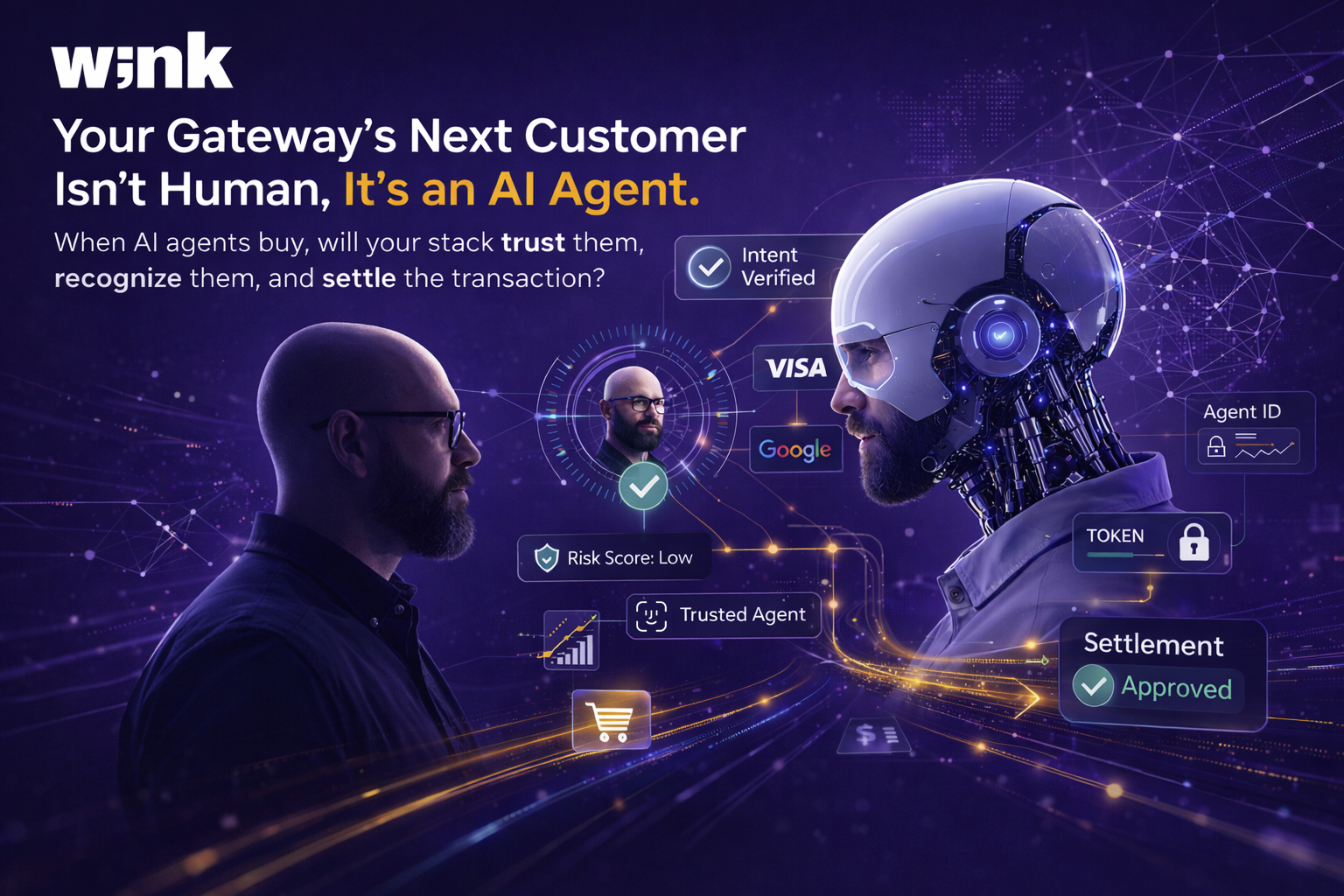
It starts quietly. A customer tells their assistant: “Find the best option. Use my preferences. Check out.”
And the assistant doesn’t just recommend — it executes. That shift is already showing up in real traffic. Visa reports AI-driven traffic to U.S. retail websites surged more than 4,700% over the past year.
The question for payments isn’t whether agentic commerce is real, it’s this: When AI agents buy, will your stack recognize them, trust them, and settle the transaction on your terms? Because in an agent-driven world, your gateway stops being plumbing. It becomes the control plane.
Over the last year, the industry hasn’t just shipped features. It’s been shipping protocols.
Not “better checkout pages.”
Not “smarter bots.”
Protocols.
Across the ecosystem, we’re seeing convergence around a new architecture:
Google’s Agent Payments Protocol (AP2) introduces cryptographic “mandates” that prove user authorization. OpenAI and Stripe’s Agentic Commerce Protocol (ACP) aims to formalize agent-driven purchase flows.
Visa’s Trusted Agent Protocol (TAP) enables merchants to distinguish legitimate purchasing agents from hostile automation.
Mastercard’s Agent Pay extends tokenization into machine-led commerce. Coinbase’s x402 revives HTTP 402 for machine-payable APIs.
Anthropic’s Model Context Protocol (MCP) enables secure tool connectivity across systems.
This is what a platform transition looks like.
Agentic commerce isn’t a feature trend. It’s an infrastructure shift.
In the human-click era, the gateway optimized for throughput:
In the agent era, the gateway optimizes for authority.
Because agent flows introduce new requirements:
Agents don’t “try again later.” They retry instantly. They don’t hesitate or abandon a cart—they execute according to code. That changes the foundation commerce runs on. Agentic commerce won’t scale on checkout pages or UI optimizations; it scales on identity, tokenization, and policy enforcement working together beneath the surface. That infrastructure layer—where intent is verified, authority is enforced, and transactions are settled securely—is the control plane.
Agentic traffic doesn’t just add volume. It amplifies complexity.
Multi-gateway sprawl, inconsistent rule sets, and fragmented routing logic become magnified when machines transact at speed.
Embedded commerce must “just work” across channels — while preserving token continuity and fraud controls.
You need to welcome agent buyers without turning your checkout into a bot magnet — or surrendering your customer relationship to someone else’s interface.
When the interface moves upstream to an AI assistant, the gateway becomes your last line of control.
Wink is built around a simple premise: don’t rent your payments engine — control it.
Because when the gateway becomes the control plane, ownership matters.
Wink offers a licensing model designed for platforms and ISOs that want to operate under their own brand and control how payments evolve.
Not someone else’s abstraction layer.
Tokenization and vaulting provide secure repeat usage across devices and channels — essential when agents transact on behalf of users.
Orchestration handles the edge cases agents create:
When transactions accelerate, routing intelligence becomes infrastructure, not an add-on.
As agents accelerate checkout, risk controls must evolve with them.
Velocity rules, behavioral analysis, token governance, and identity-linked signals become critical when “fast” is the default state.
Automation doesn’t reduce fraud risk. It compresses the timeline. A gateway built for machine-led commerce must enforce policy at machine speed.
If you’re preparing for the next phase, start here:
This isn’t a UI refresh, it’s an architectural recalibration.
Agentic commerce isn’t about who builds the flashiest assistant. It’s about who controls settlement when the assistant executes. The brands that win won’t just support agent traffic, they’ll confidently say:
If the gateway is becoming the control plane, it’s time to treat it like one.
Learn more about Wink Payment Gateway:
https://wink.cloud/commerce/payment-gateway