Blog
Nobody Needs To Know How Old You Are

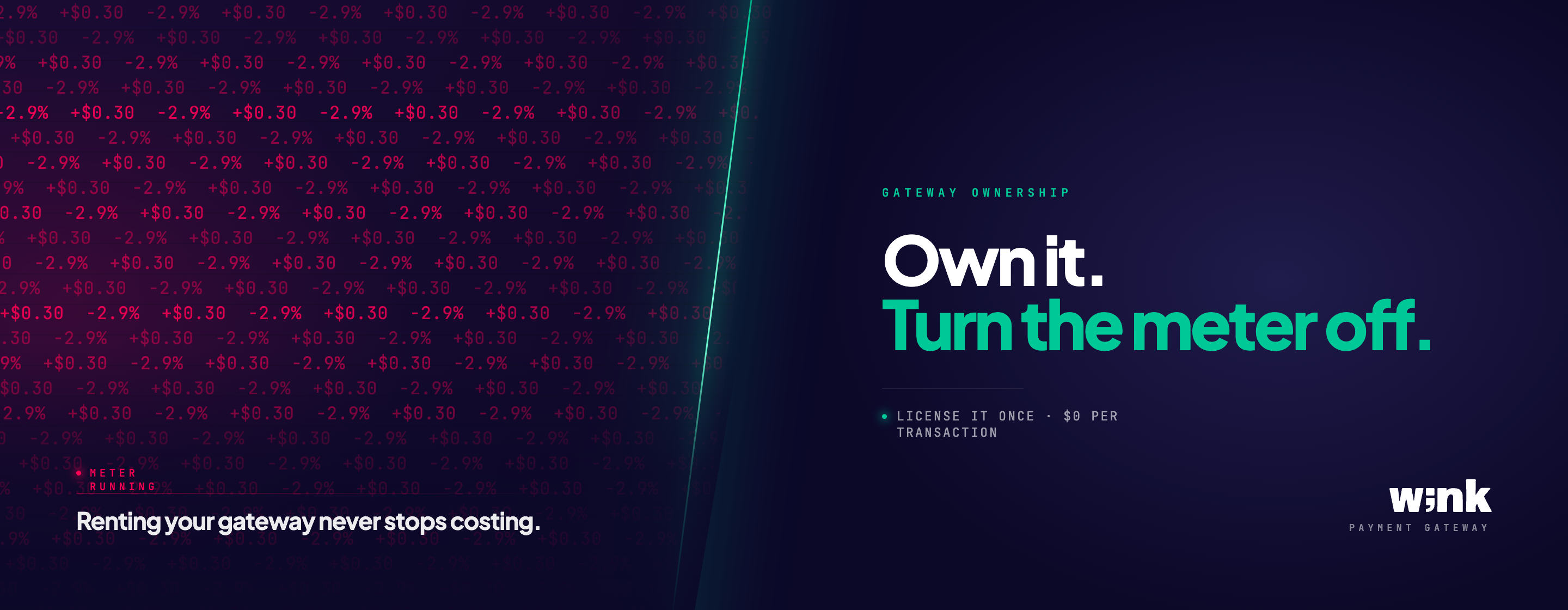
Every time a card clears, someone takes a cut. Two percent here, thirty cents there — it is easy to overlook at low volume. But at ten million transactions a month, that math becomes the single largest line item on your P&L that you did not have to pay.
The payment gateway market is projected to roughly triple by 2035, with analyst forecasts ranging from $82 billion to more than $115 billion. A significant portion of that growth is merchants, ISOs, and banks finally running the numbers and realizing they have been subsidizing someone else's infrastructure for years. The question is not whether to own. The question is when — and how.
The chart above does not need exact numbers to make its point. A per-transaction model is a variable cost that scales with your success. A flat license is a fixed cost that does not. At some point — and for most mid-market processors, that point arrives earlier than they expect — the lines cross. Everything to the right of that crossover is margin you are currently handing to a third party. This is not just our view: industry analysts now expect gateway pricing to shift toward flat and subscription models as per-transaction take-rates compress under orchestration and real-time payment rails.
THE COST OF RENTING
For a large share of U.S. eCommerce, Stripe is not a decision anyone actively makes — it is the default that came with the platform. That dominance is not because it is the best option at scale. It is because it is the fastest option at the start. Zero upfront cost, live in days, PCI compliance handled. For a startup processing its first million dollars, that trade makes sense. For an ISO with 35,000 merchants and $3.5 billion in annual volume, it is a different calculation entirely.
The per-transaction model was designed to let you grow first and pay later. The problem is that "later" never stops. The fee does not taper as you scale. It grows with you. That is not a partnership — it is a toll booth.
When you own the gateway, you can spin up reseller and merchant sub-tenancies, mark up features, and bill downstream. The license becomes a revenue tool.
YOUR OPTIONS
The decision is not binary. "Own vs. rent" is the wrong frame because there is a spectrum, and where you land on it should depend on your volume, your team, and your timeline — not ideology. Here is an honest breakdown of all three models.
THE OBJECTION
If you have looked at payment infrastructure in the last year, you have been told that the single gateway is a legacy idea. That the modern approach is an orchestration layer sitting above many gateways, routing each transaction to whichever path performs best. Roughly half of online merchants now use more than one payment provider, and an entire category has grown up to manage that complexity.
It is a fair question, and the answer is not that orchestration is wrong. The answer is that orchestration and ownership solve different problems, and most of the people asking are conflating them.
Orchestration is a routing decision. It exists because a business selling in twelve countries needs local payment methods, redundancy when an acquirer degrades, and least-cost routing across providers. If that describes you, you need it. What orchestration does not change is the economics underneath. You are still renting every gateway in the stack, and now you are paying a layer on top for the privilege of coordinating your landlords. The routing gets smarter. The per-transaction meter keeps running, and you still own nothing at the end of it.
There is also a quieter point that gets lost in the orchestration pitch. A gateway you own with direct acquirer connections is already routing across processors. Multi-processor flexibility is not exclusive to the orchestration category. It is a property of any gateway that has done the certification work, and it is why an ISO can board the same merchant on different processing platforms and control routing and risk directly.
Wink PG carries certifications across the major U.S. acquirers and processors, so routing choice is built into the license rather than purchased as a separate layer above it. For a business that genuinely operates across many markets and many providers, orchestration on top of an owned gateway is a reasonable architecture. For the ISO, bank, or processor whose real problem is that a third party is taxing every transaction, orchestration optimizes the toll. It does not remove it.
Orchestration makes the meter smarter. Ownership turns it off.
WHAT MATTERS
Not all owned gateways are equal. The license is the beginning of the evaluation, not the end. Here is what separates a real ownership play from a rebranded rental with a higher upfront cost.
THE REAL MOAT
Every point above applies to any licensed gateway that has been around long enough to mature its stack. Hierarchical white-label, real analytics, omni-commerce, solid certifications. These are table stakes for a serious ownership play. They differentiate you from Stripe. They do not differentiate you from the other ISOs who have made the same move.
There is one thing that does, and its importance is growing faster than most gateway roadmaps account for.
Over the past year, AI agents began transacting on behalf of people. The card networks moved quickly. Visa's Intelligent Commerce and Mastercard's Agent Suite are both built around "Know Your Agent" frameworks, using registration, cryptographic signatures, and network tokens to separate legitimate agents from malicious ones. Competing protocols arrived from Google, OpenAI, Stripe, and Coinbase, and the infrastructure question of the moment is which standard wins.
The harder question is the one underneath. Verifying that an agent is a registered agent is solvable with tokens and signatures. Verifying that a human being actually authorized what the agent is doing is a different problem, and it is the one the industry has not settled. Juniper Research put it plainly in April 2026: trust is the number one barrier to agentic commerce, ahead of every technical concern.
That is an identity problem, not a payments problem. It is the reason a gateway with an identity layer inside it sits in a different position than a gateway that will eventually integrate someone else's.
The near-term value is concrete and already in production: unattended commerce. Smart fridges, vending, EV charging, kiosks, and any environment where there is no cashier to check a card or an ID. Retailer demand for sub-second authentication is driving palm adoption broadly, and healthcare has been validating the modality for patient identification well outside of payments.
The longer-term value is that when a machine initiates a purchase, the question everyone will be asking is how you prove a person stood behind it. A gateway that already resolves human identity at the point of transaction is not adding a feature to answer that. It is already answering it.
Agents can be tokenized. People have to be recognized.
THE PROOF
Wink PG is built on the foundation of PhoeniXGate, which has been processing payments for Fortune 500 companies across healthcare, telecom, and financial services for more than fifteen years. A complete rebuild went production-ready in May 2026 — not an upgrade. A new stack, containerized and modular, running on modern cloud infrastructure with a 24/7 U.S.-based NOC.
Zero churn in the managed-services stream across the existing customer base. That is not a talking point — it is what happens when you build infrastructure people actually depend on, and then support it with a NOC that does not close.
We provide everything your current gateway provides. The difference: you own it.
THE FINE PRINT
Every gateway vendor will walk you through features and pricing. Very few will walk you through the operational reality of owning infrastructure. Here is the honest version — the things that catch new owners off guard, and how to pressure-test any vendor on them before you commit.
None of these are reasons not to own. They are reasons to choose a vendor who has already solved them. The managed-services model exists precisely to carry this operational weight so the license owner captures the economic upside without inheriting the infrastructure burden.
THE DECISION
The crossover point — where owning beats renting — depends on your transaction mix, your margin requirements, and your strategic horizon. But there are three signals that show up consistently before organizations make the move: