Blog
Nobody Needs To Know How Old You Are

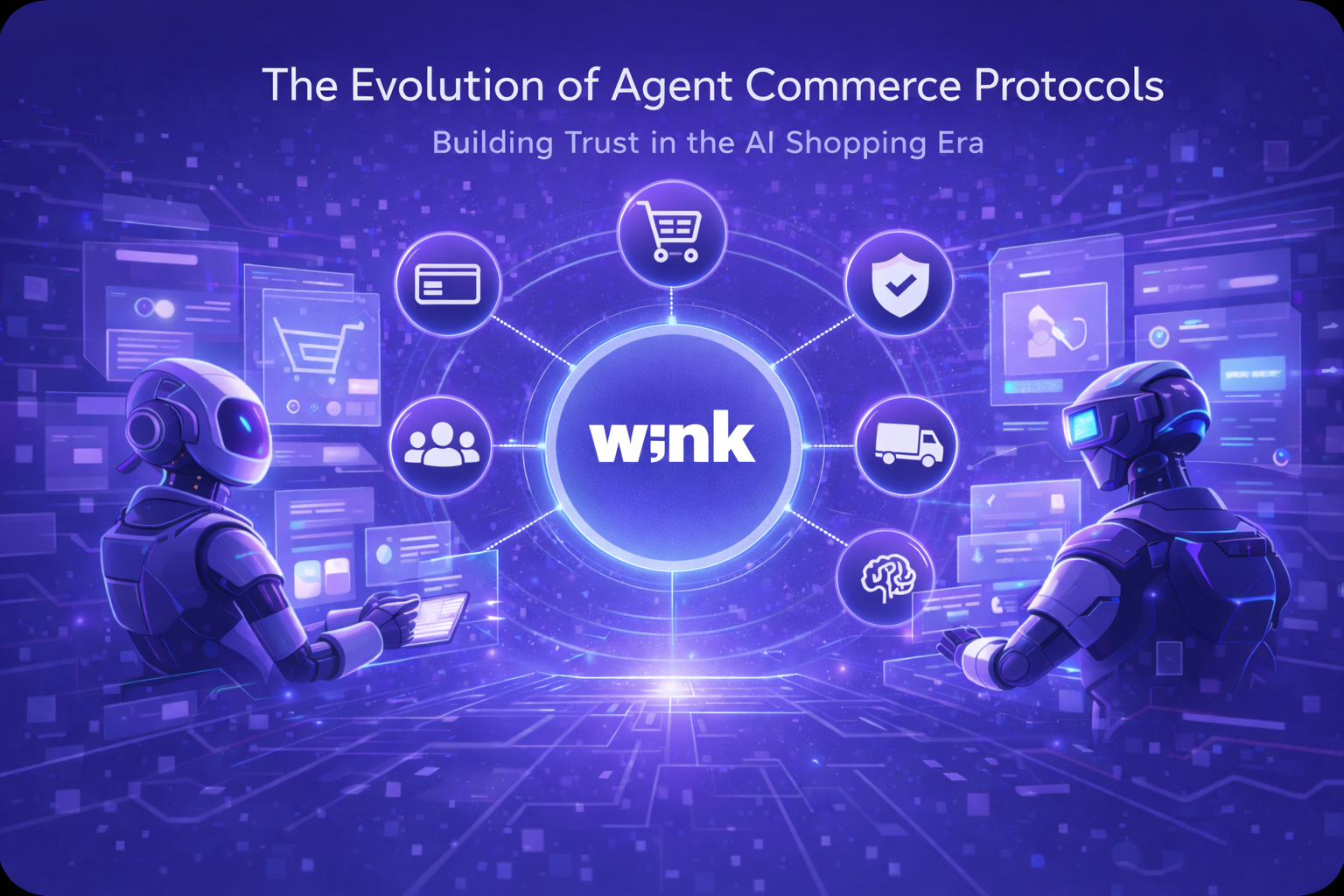
The landscape of digital commerce is undergoing a fundamental transformation. As artificial intelligence evolves from simple chatbots to sophisticated autonomous agents capable of executing transactions, a new infrastructure layer is emerging to enable this shift. Agent commerce protocols are establishing the foundation for a future where AI systems can safely discover products, negotiate prices, and complete purchases on behalf of users across platforms.
For decades, digital payment systems operated on a simple premise: a human user directly clicks "buy" on a trusted website. When autonomous AI agents initiate purchases, this fundamental assumption collapses, creating critical questions about authorization, authenticity, and accountability. Who's responsible if an agent makes an unauthorized purchase? How can merchants verify that a transaction truly reflects a user's intent rather than an AI hallucination?
These challenges have prompted major technology companies, payment processors, and financial institutions to collaborate on open standards that engineer trust into agent-driven transactions.
Announced in September 2025, Google's Agent Payments Protocol represents a comprehensive framework for secure agent-led transactions. Developed in collaboration with over 60 organizations including Mastercard, American Express, PayPal, Adyen, and Coinbase, AP2 establishes a payment-agnostic system that works across credit cards, debit cards, stablecoins, and real-time bank transfers.
The protocol's innovation centers on mandates—cryptographically signed digital contracts that provide tamper-proof verification of user instructions. AP2 distinguishes between two shopping scenarios:
Human-present transactions involve active user engagement, such as asking an agent to purchase specific running shoes. The user's approval generates a Cart Mandate that confirms their explicit intent for that exact purchase.
Human-not-present transactions cover autonomous scenarios where users set parameters like "book a hotel in Palm Springs for under $700" and allow the agent to search and execute within those constraints. An intent mandate defines the boundaries within which the agent can operate.
This dual-mandate system addresses key concerns around authorization (proving the user granted specific authority), authenticity (ensuring the agent's request accurately reflects user intent), and accountability (establishing clear responsibility if issues arise).
AP2 extends both Google's Agent2Agent protocol and Anthropic's Model Context Protocol, creating interoperability across the emerging agent ecosystem.
In September 2025, OpenAI launched Instant Checkout in ChatGPT, powered by the Agentic Commerce Protocol developed in partnership with Stripe. This marked the first major consumer-facing implementation of agentic commerce at scale, allowing ChatGPT's 700 million weekly users to complete purchases directly within conversations.
ACP defines a standardized conversation flow between buyers, their AI agents, and businesses. The protocol enables agents to reason over structured state, invoke merchant tools at each transaction step, and keep customers informed in real-time. Stripe's infrastructure handles fraud screening, payment tokenization, and secure checkout without requiring merchants to process payments exclusively through Stripe.
What distinguishes ACP is its focus on conversational buying experiences. Rather than redirecting users to merchant websites, the entire journey from product discovery through checkout occurs within the AI interface. Product results remain organic and unsponsored, ranked purely on relevance to user queries.
In October 2025, Visa introduced the Trusted Agent Protocol in collaboration with Cloudflare, addressing a critical infrastructure need: distinguishing legitimate AI agents from malicious bots. With AI-driven traffic to U.S. retail sites surging over 4,700% in the past year, merchants face an urgent challenge in verifying which automated requests represent genuine customer intent.
The protocol establishes a framework for approved agents to securely pass critical information to merchants during every transaction step. This helps merchants recognize trusted agents with commercial intent and filter out fraudulent automation.
Visa is also piloting AI-ready cards with partners including Anthropic, IBM, Microsoft, OpenAI, and Perplexity. These replace static card details with tokenized digital credentials, enabling merchants to verify that a consumer's agent is genuinely authorized to act on their behalf within preset budgets and consent parameters.
While not exclusively focused on commerce, Anthropic's Model Context Protocol has become fundamental infrastructure for agentic systems. Announced in November 2024 and immediately open-sourced, MCP standardizes how AI assistants connect to data sources, business tools, and external services.
Before MCP, developers built custom connectors for each data source, creating an exponentially complex integration problem.
MCP provides what Anthropic describes as "a USB-C port for AI applications"—a universal interface allowing any compliant AI application to interact seamlessly with compatible systems.
The protocol's architecture separates MCP servers (which expose data and capabilities) from MCP clients (AI applications that consume them). Anthropic has released pre-built servers for popular enterprise systems including Google Drive, Slack, GitHub, Postgres, and Stripe.
In the commerce context, MCP serves as the discovery and intelligence layer that precedes transactional protocols like ACP and AP2. Where MCP enables AI agents to search products, access inventory data, and retrieve pricing information, commerce protocols handle the actual checkout and payment execution. PayPal's head of AI noted that MCP's release marked the moment when agentic commerce became technically feasible, as it solved the fundamental problem of agent-to-agent communication.
Major players including OpenAI, Google, and Microsoft have adopted MCP. Payment processors Visa, Mastercard, and Stripe have aligned their initiatives with MCP standards, creating a cohesive technical foundation across the industry.
In May 2025, Coinbase launched x402, a protocol that fundamentally reimagines how payments work on the internet by embedding them directly into the HTTP layer. Rather than treating payments as a separate checkout flow, x402 revives the long-dormant HTTP status code "402 Payment Required" to make payments a native part of web communication.
The protocol's elegance lies in its simplicity. When an AI agent or application requests a paid resource—an API call, a piece of data, or access to content—the server responds with HTTP 402 and includes structured payment metadata: the exact price, the payment token (typically USDC stablecoin), and the recipient wallet address. The client signs a cryptographic payment authorization using the EIP-712 standard and resends the request with payment proof. The server verifies the payment and instantly delivers the resource—all within a standard HTTP request-response cycle.
This design eliminates the friction that makes micropayments impractical with traditional rails. Credit cards carry transaction fees of 2-3% plus $0.30 per transaction, making a $0.01 API call economically absurd. x402 transactions on Layer 2 networks like Base cost fractions of a cent, enabling genuine pay-per-use models at any scale. Settlement happens in approximately 200 milliseconds versus days for ACH transfers or hours for card authorization.
Mastercard's Agent Pay Program, announced in April 2025, builds on the company's tokenization capabilities to introduce agentic tokens. Partnerships with Microsoft, IBM, Braintree, and Checkout.com signal Mastercard's strategy of enhancing existing infrastructure to support autonomous transactions.
Skyfire's KYAPay represents a startup approach, launching Agent Checkout in June 2025 with an emphasis on verified agent identities and programmable payment capabilities. The protocol focuses on identity verification, auditability, spend control, and reputation tracking.
Virtuals Protocol, emerging from the blockchain space, proposes an AI agent commerce protocol combining co-ownership through tokenization with the GAME (Generative Autonomous Multimodal Entities) framework. While more experimental, it demonstrates how decentralized systems are exploring agent commerce from different architectural foundations.
Despite different approaches, successful agent commerce protocols share core principles:
The practical implications extend far beyond simple product purchases:
While protocols establish technical foundations, significant challenges remain:
The pace of development suggests agent commerce will expand rapidly. Current limitations—single-item purchases, geographic restrictions, limited merchant networks—are temporary constraints being systematically addressed.
Next-generation capabilities on roadmaps include:
The success of these protocols will ultimately depend not just on technical robustness but on trust—trust that agents accurately reflect user intent, trust that merchants receive legitimate orders, and trust that the entire system operates transparently with clear accountability.
As one industry observer noted, these protocols represent more than new payment APIs. They're the foundational infrastructure for an autonomous digital economy where intelligent systems handle routine transactions, freeing humans to focus on decisions that require judgment, creativity, and emotional intelligence.
Geeta Gupta is the Head of AI and Data Sciences at Wink, where she leads advancements in biometric authentication technology. With deep expertise in machine learning, statistical learning techniques, and artificial intelligence models, Geeta specializes in building robust, data-driven solutions for both supervised and unsupervised learning challenges. Her work focuses on developing sophisticated algorithms, fine-tuning model assumptions, and enhancing model accuracy through advanced datasets and classification techniques. Geeta’s approach to AI is instrumental in driving secure, innovative applications at Wink, empowering businesses to leverage biometrics confidently.